Sunday, June 28, 2015

Blogger Challenge: Why Teach?

ThisTeacherSings recently blogged about why she teaches.  She then challenged other #oklaed bloggers to address the same topic.

Homework?  It's SUMMERTIME!  But I am not one to back down from a challenge.

So, why do I do it?  Why teach?  Why did I go back to teaching after trying out the instructional coaching gig?

Answer:  It makes my heart happy.

I taught for 12.5 years before becoming an instructional coach.  Coaching became my work for the next 3.5 years.  It was an amazing experience, but there was always something missing.  I can still remember the feeling of complete and utter peace when I hit the send button accepting a teaching position in March 2014.

My heart was happy again.

When I started school, my mom purchased a spiral-bound booklet to hold all of my report cards.  On the back you were able to list different memories from each grade.  The only part I really filled in was the "When I Grow Up I Want To Be.." section.

In 3rd grade I would use purple carbon paper to make worksheets for my kindergarten brother.  Why the carbon paper?  Of course every teacher needed an answer key!

In 5th grade, I read everything there was to read on Helen Keller.  Her story is inspirational, and I was determined to be like Annie Sullivan.  Somewhere along the way I realized Annie Sullivan had a trait that I constantly have to work for - patience.  

In high school, I taught Sunday School.  I suppose at this point I started my first lesson planning experiences - except they occurred on Saturday nights instead of Sunday nights.  HA! 

I always knew I was going to be a teacher.  It was hard for me to understand my college friends who were Undecided.  How could you not know what you wanted to do with your life?  While I understand it now, it was foreign to me at the time.  

My brain thinks in terms of classroom activities/lesson plans.  In a book store, I gravitate to the teacher section.  When surfing the Internet or browsing through Pinterest, inevitably a teaching related site will appear on my screen. It takes effort to not think about teaching.

When my daughter says she wants to be a teacher when she grows up, I don't discourage her.  I don't tell her that she can make more money doing something else.  I don't tell her that she can do more than just teach.  I simply smile.  I hope that she can find something that she is passionate about.  I hope she can find something that makes her heart happy.


Friday, June 26, 2015

Thinking of August in June

Everyone is giving me a hard time for being in my classroom already, but I can't help it.  I LOVE getting ready for a new school year.   A move down the hall and around the corner also gives me the excuse of changing classrooms thus needing to be in my room early.  :-)

Classrooms should be inviting places that promote learning.  Students need to feel safe and comfortable.  Students who have not yet discovered a love of reading will hopefully have a chance this year to find their inner readers.

I am super excited about my reading corner.  If you can't find me, I might be curled up there with a book.

My kids attended VBS, and they had AMAZING trees.  I decided I needed to have one, so I searched Pinterest.  After a trip to Dollar Tree, I had my supplies and got started!

4 Pool Noodles
Lunch Bags (I used around 50)
Duct Tape
Tissue Paper
Hot Glue Gun


Arrange the pool noodles and use duct tape.  You are covering it with the paper; it doesn't matter what it looks like underneath!  I did use some plain brown wrapping paper for the thicker part at the bottom.  Just crumple before taping down.  Cut the bottom off of the paper bag open it up, and then crumple (or smash it if you are having a bad day!).  Open it back up and slip it over the end of the pool noodle.


I propped it up for a better visual.  The tree is 1 1/2 pool noodles tall.  Taper the ends of the noodles.


I kept adding branches until I was satisfied.  I also add some roots to the tree to help keep it propped up.  I had a thick cardboard tube that was in the center of the rug purchased on clearance at Target for only $30!.  


I have found the best adhesive to the cinder block wall is hot glue.  I tested it last year and was satisfied it would not peel the paint.

I used three different shades of green tissue paper to create the leaves.  I could write all the steps or just direct you to the link I used from All Things Mamma. I modified it a bit while fluffing to fit the shape I wanted. I used hot glue to attach these to the ends of the branches.


I was worried when I started this project that it would be a Pinterest Fail, but I am very happy with the results.

My other project this week was making my READ letters.  I used the cardboard letters from Hobby Lobby and painted them red.  I traced the letters onto scrapbook paper and cut them out. Then I used a thin layer of Modge Podge to adhere it to the letter.  Once it had dried, I coated the whole letter with Modge Podge to seal.  


After a week and half in my room, I have about 1/6 of it done!  And you wonder why I am in my classroom already!

I need to take a decorating break for a few days in order to focus on the new Oklahoma ELA Standards.  We'll be working on Draft 2 in order to have it ready for EngageOK.  Be sure to register if you haven't done so yet!

The Book Whisperer: Awakening the Inner Reader by Donalyn Miller arrived at my door this week. I can't wait to delve into this book.  Who doesn't want to help a children find their inner readers?

I would love to read about what you have been doing this summer!


Thursday, March 19, 2015

A Productive Week (March 9)

I promise I didn't forget about reflecting.  Several drafts have been floating around in my head.  Besides it being the week before Spring Break, I was also planning a trip to Iowa.  One of my best friends laid her father to rest, which led to lots of reflection that wasn't school related.  Time was spent discussing where we wanted to be buried.  The whole conversation was surreal because these were the same girls with whom the biggest question used to be, "What are we doing tonight?"

But back to education...


I'm dedicating this week to TPT.  While I could have created all of this on my own, I decided to support my fellow educators and not reinvent the wheel.  I may have improvised and improved the wheel some, but isn't that what we do with any materials we use?


Monday, March 9

We continued working with the Dog Day information my students started the previous Friday.  I impressed the kids with my math skills.  Who knew their English teacher knew how to add and multiply?!?  Researchers need many skills to make informed decisions!  With their new/reinforced knowledge, students decided which type of dog they would try to persuade their parents to allow them to have.  
Math - in English!
This activity went okay.  It took MUCH longer than I anticipated.  We only got about half of what I wanted to accomplish completed.

Tuesday, March 10
Students came to class with their graphic organizers completed.  The hard part is done!  I modeled how to turn the question from the graphic organizer into a topic sentence.  We then worked together to create topic sentences for the other three paragraphs.  Students then had time to complete their persuasive letters.  One student asked me to please put a picture of our topic sentences on Instagram.  YES!  I took a picture of every hour and posted it on our Instagram account as well as on our class website.

Today was a good day.  Students had decent ideas for topic sentences.  This allowed students who struggle with a place to start each paragraph and allowed those with better writing skills to refine/expand what we discussed in class to in order to create their own topic sentences.

Wednesday, March 11
Generalization is the word of the day.  From my very unscientific poll, about 10 students knew what a generalization was before this lesson.  I found a through explanation in this PowerPoint on TPT.

Making Generalizations Powerpoint (including valid vs. faulty)

I'm not one to do PowerPoint karaoke, so I had to find a way to make it interactive and keep the students engaged.  My simple solution was to give each student a note card.  As we went through the slides, students analyzed the examples and held up the side of the card they felt it represented.  Understanding the difference between fact, opinion, and generalization will aid in their persuasive/argument writing.


While I enjoyed sharing this information for the first three classes, I had to really focus with my last three classes.  It is hard to keep up the WOW! factor after doing the same lesson multiple times.  

Thursday, March 12
Yesterday my students demonstrated they could pick out the valid and invalid generalizations, so I now needed them to write their own.  First we reviewed the signal words.  Thank you, Crafting Connections!

To practice this new skill, students worked with partners.  There were six different examples with sports facts on them.  Students were required to write a valid generalization and an invalid generalization on sticky notes.  Then they rotated to the next station.  While at the new station, they had to read the facts and read the generalizations the previous group wrote.  To make life interesting, students could not use the same signal words as the previous group.  The kids just LoVe when I do things like that to them!  

Writing valid and invalid generalizations.

This picture makes me smile.
It has 6th grade written all over it.

It was one of those days that I left satisfied.  I was able to walk around, spot check, and clarify for students who needed some extra help.  Reading the sentences allowed me to correct misconceptions before we advanced too far into the activity.  

I did miss my 3rd hour today.  A pep rally was held for our high school girls' basketball team.  They won Thursday night, but they lost on Friday.  :-(  

With three days left of Spring Break, I had better get planning what to do next week!

Saturday, March 7, 2015

My Week in a Nutshell

So....I haven't blogged for 6 months.  I always mean to, but I've struggled with the content.  That changed today.

I attended the Blog to Blogger session at EdCampOKC.  During the session, Kevin Hime made a what-if comment.

What if teachers did not have to turn in lesson plans but had to write a reflective blog every week about what they had taught?

My mind has been whirling ever since.

Here it goes:  What did I do the week of March 2?

Monday - My 6th graders have been learning how to use different research tools, specifically Encyclopedia Britticana and EBSCO.  We researched the Mayans (what they are studying in geography) using Encyclopedia Britticana last Friday, so I decided to have them hone their EBSCO skills on Monday.

Since it was Dr. Seuss' birthday, I created a guide in which students would research Dr. Seuss.  While it seemed worksheet-ish to me, I also knew that they needed to learn the features of EBSCO.  Sixth grade needs step-by-step!  The students were engaged, learned more about how to use EBSCO, and seemed to enjoy the activity.

Tuesday - This was one of those days when multiple students were missing from every hour.  Students were gone for Math Counts, a band contest, and a pig show.  My students always want to read the play from our Scholastic Scope, and this month's play happens to be The Newsies.  It fit perfectly with the reference materials we have been discussing.  The primary source photographs helped students gain a better understanding of the text and time period.  After reading through the play individually,  I used the random generator feature of Class Dojo to let students either choose a part to read or pass.   After reading, we analyzed the tone of the photographs.  Students had a blast reading their parts.  I know my students were engaged when I hear, "Class went so fast today!".

Wednesday - SNOW DAY

Thursday - SNOW DAY

Friday - I had a substitute so I could help moderate at our Academic Team's Area Contest.

There you have it - my week in a nutshell.  I feel as though I cheated since it was really only two days.  But hey, we have to start somewhere!


Saturday, August 30, 2014

An Epic Fail


How often, as teachers, do we ask our students to try again?  How often, as teachers, do we apply this to lessons that might not have gone so smoothly?  

Often people blog about the amazing things that are accomplished in a classroom.  Today I am going to blog about a failed lesson.  A Train Wreck in Slow Motion.  An Epic Fail.

It started first hour.  First hour is always the guinea pig hour.  We all know it is true.  Rarely do I do something second hour that was exactly the same as first hour.  Today we were walking through a planning page for an argument essay.

Me:  Step 4 is where you will write your thesis statement.
Students (blank looks):  I don't know what that is.
Me:  Hmm.  You know, the thesis statement.  I know you know what one is as you all wrote essays in 5th grade.
Students (more confused looks):  We didn't do that.
Me:  Hmm.  Welllll, I am going to have to talk with your 5th grade teacher to find out what vocabulary she used.  I know as soon as I say that magic word, you will all know exactly what I mean.  In the meantime, let me give you a thesis statement.

At this moment several things went through my mind. 
  1. I know better than to assume.
  2. I should have made the time to visit with the 5th grade teacher about what she had taught last year.
  3. I should have modeled more of the writing.  I was rushing because I wanted the three-day weekend to grade the essays.
  4. I was going to have to change the rubric.
  5. I have to do this five more times today.  How can I fix this?
By the time second hour rolled around, I decided it would be okay that I was giving them the thesis statement.  There are many components to an essay, focus could easily be shifted to other areas.  

By the end of third hour, I was chalking this up to a learning experience.  I learned many things NOT to do/assume again.  To make peace with the time my students and I invested in this assignment, it was decided to use it as a pre-test.  Essays will be graded as more of a completion grade, and data will be used, in the form of their written words, to make instructional decisions.  Analysis started as I was helping students edit rough drafts on Friday.

Things They Know
Lesson Plans to Create
Basic sentence structure
Thesis statements  J 
Capitalization
Using transition words effectively
Indenting paragraphs
Subject-Verb agreement
Staying on topic
Counterpoints (argument writing)
Citing sources (more did than didn’t)

How to write a hook/attention grabber


 Both lists will have several additions once I sit down with their final drafts next week. 

Thinking about it later, there are ways the experience could have been the Epic Fail I first claimed it was.
  • Playing the blame game 
    • These students just don't care...
    • If those teachers in 5th grade would have...
    • The parents need to step it up and help their children more...
  • Scrapping the assignment after first hour 
  • Giving up on writing.  I mean, really, I'm not a tested subject after all.
Thankfully, those are not the thoughts that ran through my head.  I have always believed that self-reflection is a crucial step in improvement. There are many directions my Thursday-Friday could have taken.  I will admit, there was a brief pity-party until my teammates reminded me it wasn't really an Epic Fail.  Information was gathered and lessons were learned.  

This time it was the teacher that learned the most.


Wednesday, August 20, 2014

Informal vs Formal Language - Creating Anchor Lessons

Wow!  The beginning of the year is off to a fantastically furious start.  I wanted to post about my first days back in the classroom, but I was a little overwhelmed trying to figure everything out!

I would like to share a lesson I did on Tuesday.  Starting the year with memorable Anchor Lessons that are referred to all year is a successful tip from my Pre-AP Training.

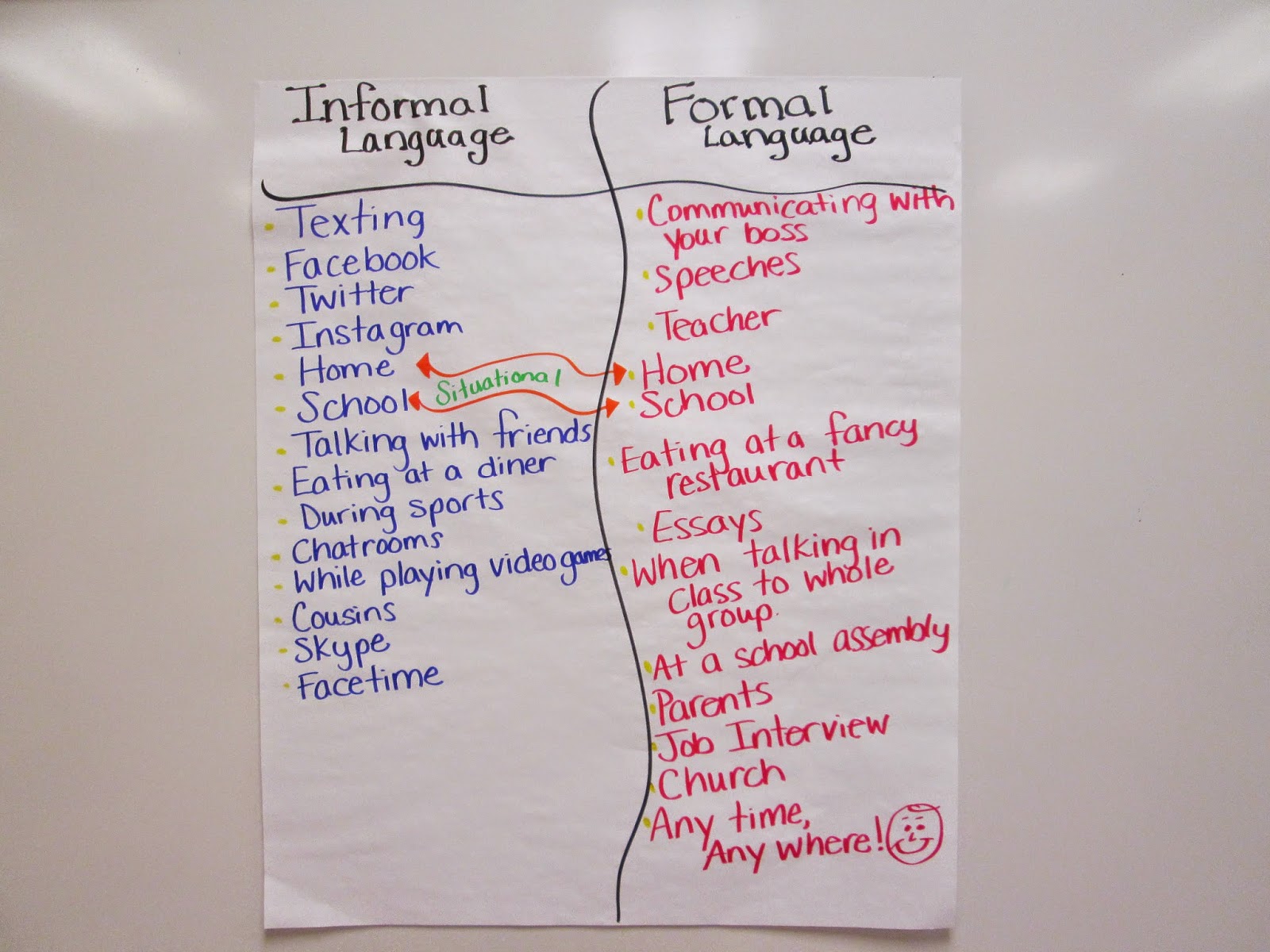
Since my class is English, and I want the students to use formal language when writing and speaking, I created a lesson on informal vs formal language.

As I posted about earlier, my lessons always follow the Daily Elements of MAX Teaching.


The first question involved simply thinking about what the term Formal Language meant.

Students then completed a sentence sort.  Each pair received 20 sentences.  They were to each take 10 and sort them into Formal and Informal.  After the individual sort was complete, students were able to work together to put all 20 sentences into the correct categories.  

After students worked with examples of informal and formal sentences, they completed the next task.


They LoVeD writing on the board.  

I snapped a quick picture of each hour's information so I could combine the ideas on an Anchor Chart after school.   I think one of my favorites was "eating at a diner" for Informal and "eating at a fancy restaurant" for Formal.  And, just as an FYI, the Olive Garden is a fancy restaurant!


A discussion of Text-Message Language, Informal Language, and Formal Language was next.


Students chose a phrase and wrote it the three different ways.  After sharing with their small group, they choose one person's phrase to put on a sticky note and add to a class poster.  Again, I combined ideas from each hour to create an Anchor Chart.


The culminating activity consisted of students writing a text message, an informal private Facebook message, and a formal request to Amazon about receiving the wrong necklace for Grandma.

Students left class saying they had "fun"...which I think is a good day in the land of 6th grade!  I will use the anchor charts as reminders before we write over the next few weeks.  Later it the year I can again pull them out if informal language starts creeping its way into our classroom.

How do you teach the difference between the language registers?


Tuesday, August 5, 2014

Setting Expectations, Part 2

Last week I wrote my plans for creating my "How Are We Learning?" anchor chart.  


Admittedly, as I was planning, a little part of me kept thinking that I should be the one setting the expectations.  I want students to know what I expect of them - how can I do that if they wrote the expectations?

Then this article showed up in my Facebook newsfeed - Why You Shouldn't Let Your Students Decide The Class Rules.  (Thanks to Teaching the Core for always posting great stuff!)
The unintended message students receive by taking part in creating the very boundaries of your classroom is that everything is negotiable, which then opens the floodgates to debate on matters that should only be decided by you.
With this in mind, I  made the decision to post my expectations prior to the students entering my classroom. 
By presenting your rules as non-negotiable boundaries that you put into place for the express purpose of protecting their right to learn and enjoy school, you establish yourself as a compassionate leader who puts their interests first.

My red arrow is laminated and has a piece of sticky wax on the back so that it can easily be moved as we progress through a class period.

A colleague is fond of saying "I'm never in the land of done."  These words ring so true with me.  As we continue to learn and grow as educators, we need to be willing to change our plans.